Life

5 Conversation Starters for Making Friends After College

For those of us who have a longtime circle of friends or struggle with social anxiety, meeting new people can be nerve-racking. What do we say and what impression will they get? 

The most important thing is to remember that you are both human, both imperfect and both just trying – no need to be afraid. After getting over this fear, here are a few interesting questions you can ask to get the conversation going!

1. Tell Me About Yourself.

Whether we like to admit it or not, it’s scientifically proven that we all love talking about ourselves. Believe or not, everyone’s story is pretty interesting. You’re the only one who has ever lived the life you live and people want to hear about it.

2. What’s Your Favorite Social Media Platform?

Are you more of a Facebook gal or the Twitter guy? Over 3.6 billion people have some form of social media and most of us have lots of opinions about it. This is a great opportunity to learn about people’s likes and dislikes and can give clues on what other things may interest this person.

3. Stream Anything Good Lately?

You know that series everyone’s talking about? Yeah, that one – talk about that. What we watch sticks with us, and in a way, we become experts on it. Give ideas, opinions and other similar suggestions.

4. What Are Some of Your Favorite Hobbies?

Bring out feelings of joy by discussing what people like to do. You’ll be surprised by how they light up. Talking about hobbies is always fun and can create an avenue for deepening the relationship through quality time engaging in that hobby together.

5. How Are You Enjoying the Weather?

It’s pretty standard, but it works. People’s reaction to the weather can give insight on their life context and upbringing. Why do you love the cold? Have you always enjoyed Autumn?

Making friends after college can be difficult, but it’s not impossible. Use these conversations starters and research more if needed. Let us know how it goes!

Kindly,

Post Graduate

P.S. Don’t forget to follow us on Facebook and Instagram!

Career

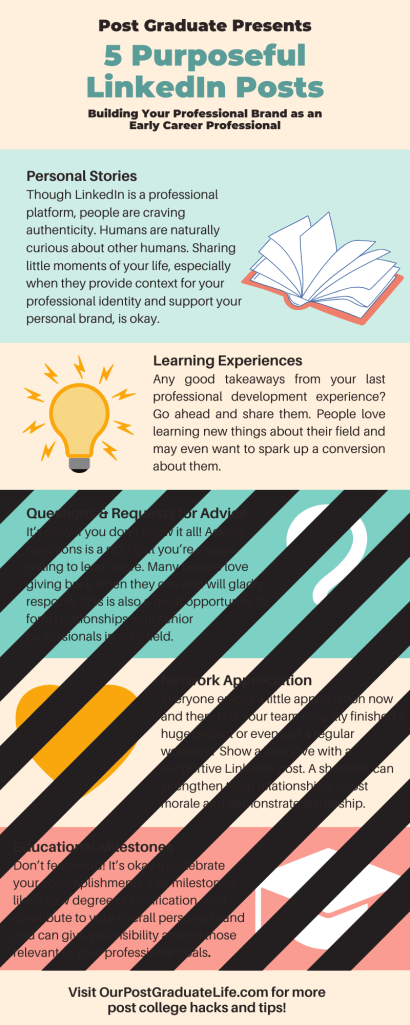
The 5 Best LinkedIn Post Ideas for Recent Graduates in 2021

When used correctly, LinkedIn can be a powerful tool for career advancement and networking. Think about it. Access to millions of normally hard-to-reach industry professionals is right at your fingertips.

It’s a completely free opportunity to make a good impression, hear from the experts and add meaningful connections to your professional community. LinkedIn is great, especially for those just starting out.

The only question now is, “What should I post?” You don’t have to wait until you get another new job or have another major career change before you start communicating. Here are five types of purposeful posts you can start creating right now!

Download our free infographic to begin building your post graduation personal brand on LinkedIn today.

Professionally,

Post Graduate

Career

5 Things to Consider Before Quitting Your Job

It’s happened to many of us. You work a job for months or years possibly browsing other options here and there for one reason or another, and then seemingly out of nowhere a real opportunity arises for a change and you now have a life-altering decision to make.

What do you do?

That’s what many of us have asked ourselves. It can be scary, especially if you’ve been in a position for a long time, perfected your craft and made tons of work-friends. In many cases, the answer is clear, but sometimes we are left paralyzed and unsure of what to do which doesn’t mesh well with the sometimes short timeframe we are given to make decisions with such a lasting impact.

If you’re feeling like a professional ice cube at the moment frozen with uncertainty, here are a few questions to ask yourself.

Why am I doing this?

Sitting back for a moment and simply asking yourself “why” can surprisingly clear up a lot of confusion. Sometimes we’re in such a hurry to get to the finish line we forget why we started running in the first place. After you jot down what’s really going on in your head, you may have more clarity about what you really want and why. 

Is this an emotional decision?

Let’s be honest, we all have bad days. Your supervisor may have made you stay late for the third Friday in a row, a challenging colleague may have sent your task back with yet another round of heavy revisions or you may have gotten into yet another respectful, but uncomfortable disagreement. All of these scenarios happen all the time, but are they significant enough to turn in resignation papers? Learn to distinguish a bad day from a bad work situation.

How will this impact my career in the long run?

If you have longterm career goals, such as becoming an executive or occupying a hard-to-get position within your industry, you may want to think ahead and try to guesstimate how this change will impact that. Sometimes changing organizations means rebuilding trust and loosing a bit of authority, even if the new position is higher up the organizational ladder. Your previous employer has seen your skills and deemed you worthy of  great responsibility. If you transition, you may have to demonstrate who you really are for a while before you regain this type of power and flexibility.

Is money the motive?

Sometimes life circumstances will demand the need for more money, and that’s okay. But other times a bigger paycheck is just a glittery obstruction. We see those around us who we have about the same amount of experience or even less with bigger paychecks and automatically feel we deserve the same. While that may be true, we can’t always afford to have money be the driving factor. We must also take into consideration what the organization actually stands for, its core values, how it treats its employees, work culture and other important factors. A big salary shouldn’t blind us from seeing the big picture.

Am I afraid to admit the obvious?

Sometimes we know right away what we should do, but we’re just afraid. We’re afraid to turn down what seems like a once in a lifetime opportunity, even if it’s not right for us, or we’re afraid to leave a place where we’re now not only professionally invested, but also emotionally invested. Use the courage you do have to make what may be one of the hardest decisions and remember it can also be one of the best decisions. 

We believe in you and we’re excited for your future. Share this with anyone who is in the process of making a tough professional decision.

Wishing You All The Best  In Your Career!

Post Graduate

Career

Five Lessons from My First Job Out of College

If you’re reading this, congratulations! All of your hard work has paid off, and although you’ll still have to work hard, now, you’ll actually get paid for it. You’re at the official start of your career and ready to take the work world by storm, as are millions of your peers worldwide.

I was just like you, confident, prepared and ready to learn more; however, there are areas I wish I knew how to handle better, small things that can have a big impact, and as a result, I’m sharing them with you.

When you come across complex situations at work, an experience that is almost inevitable, I want you to have this as your toolkit for informed decision-making and interactions. 

Here goes!

1. Pay attention and observe.

Don’t be afraid to scope out the scene. As humorously pointed out on social media, when new employees join a company or organization, people for some reason feel the need to paint their workplace as a pristine utopia, showering you with smiles and “you’ll love it here’s.”

While that may be true, wherever there are people, there is imperfection. I am not trying to bring down your mood, but to be realistic. Look for the pain points, the troublemakers and the soft spots. You can actually turn this around for good!

After taking note of these elements, you can use your knowledge and what may start off as a light workload to begin providing solutions to these problems. As for the trouble-makers, I’m not saying for you to go and try to be a life-changing intervention, but take note of their interaction style so you’ll know how to work with them when the time comes. That leads me to my next point.

2. Don’t be afraid to make suggestions.

While there may be some who are a bit intimidated by newcomers (again, another cringe-worthy truth), most will be excited for a fresh perspective and set of ideas. People want what you have to offer, and that’s why you were hired.

Don’t be afraid to chime in during appropriate moments at meetings or speak with your supervisor afterward about possibly presenting your new ideas in the next one. People both want and need what your unique perspective brings.

3. Stay teachable.

With that being said, don’t get big-headed. You know a lot, but not everything. Remember you (in many cases, but not all) will sometimes will be surround by decades-long career veterans who know the industry and know it well.

While they may not be up-to-speed on the latest trends, they have a strong understanding developed over several years of what works and what doesn’t. Don’t just respect them, learn from them and add their approach, as appropriate, to your toolbox as well.

4. Be yourself.

You will spend a third of your day at work if you have a traditional schedule. That’s a lot of your life spent with co-workers. Now, I am by no means encouraging you to be a kiss-up or fall into the trap of people pleasing. I am not even saying you have to be best-buddies with your coworkers, but you do want to have some type of relationship.

At least be on good terms. Say hello, ask them how they’re doing, give them updates on how you’re doing, and just be yourself. Attend a few after-hours office events and holiday parties to build on your in-office chemistry. 

Don’t expect or try to get everyone to like you, but make an effort to be professionally cordial to improve the enjoyability of your at-work experience.

5. Be generous.

Over the years, I’ve noticed that those who are the most successful, both in and out of the office are the most giving. When I say giving, I am not taking about money, I’m referring to grace, kindness, favors and time.

Now, don’t become that person who clearly does stuff for others just to get ahead, another type of kiss-up, but be genuine, be authentic. Do it because that’s who you want to be as a person and the lifestyle you want to live.

What may help is listening to your intuition to determine just the right moment to do so. Send someone an email telling them they did great during a presentations, bring in donuts for the office or offer to help someone (only if you can) who has an extra heavy workload for the week. 

You’ll know when its time.

I believe in you and your power to make an impact in your everyday work life. Keep an encouraging message on your desk everyday to remind you of your true potential and power!

Here’s to a Successful Career!

The Post Graduate